
CPP Contributions in 2026: A Payroll Compliance Essential
CPP Contributions in 2026: A Payroll Compliance Essential
CPP Contributions in 2026: A Payroll Compliance Essential
The Canada Pension Plan is often talked about as a retirement benefit, and it is. But on the payroll side, "CPP" means something narrower and much more immediate: a mandatory deduction that must be calculated correctly on every pay run, matched by the employer, and remitted to the Canada Revenue Agency (CRA) on schedule. Confusing the benefit side of CPP with the payroll side of CPP is where a lot of errors start.
Since 2019, that payroll-side calculation has also gotten more complicated. What used to be a single flat-rate deduction is now a two-tier calculation, and the second tier (CPP2) catches many payroll processors off guard because it doesn't behave like the first tier at all.
What Is CPP, From a Payroll Perspective?
For payroll purposes, CPP is a source deduction: an amount withheld from an employee's pensionable earnings and matched dollar-for-dollar by the employer, then remitted to the CRA alongside income tax and Employment Insurance (EI) premiums. Self-employed individuals pay both the employee and employer share themselves through their annual tax return.
CPP contributions are calculated on pensionable earnings, not gross pay in every case, since most employment income counts, but certain amounts (such as most non-cash benefits below prescribed limits) may not. Contributions apply between a basic exemption and one or more earnings ceilings, and it's the ceilings, not the rate itself, that tend to change most from year to year.
The Two-Tier Structure: Base CPP and CPP2
As of 2026, there are two layers to the calculation:
-
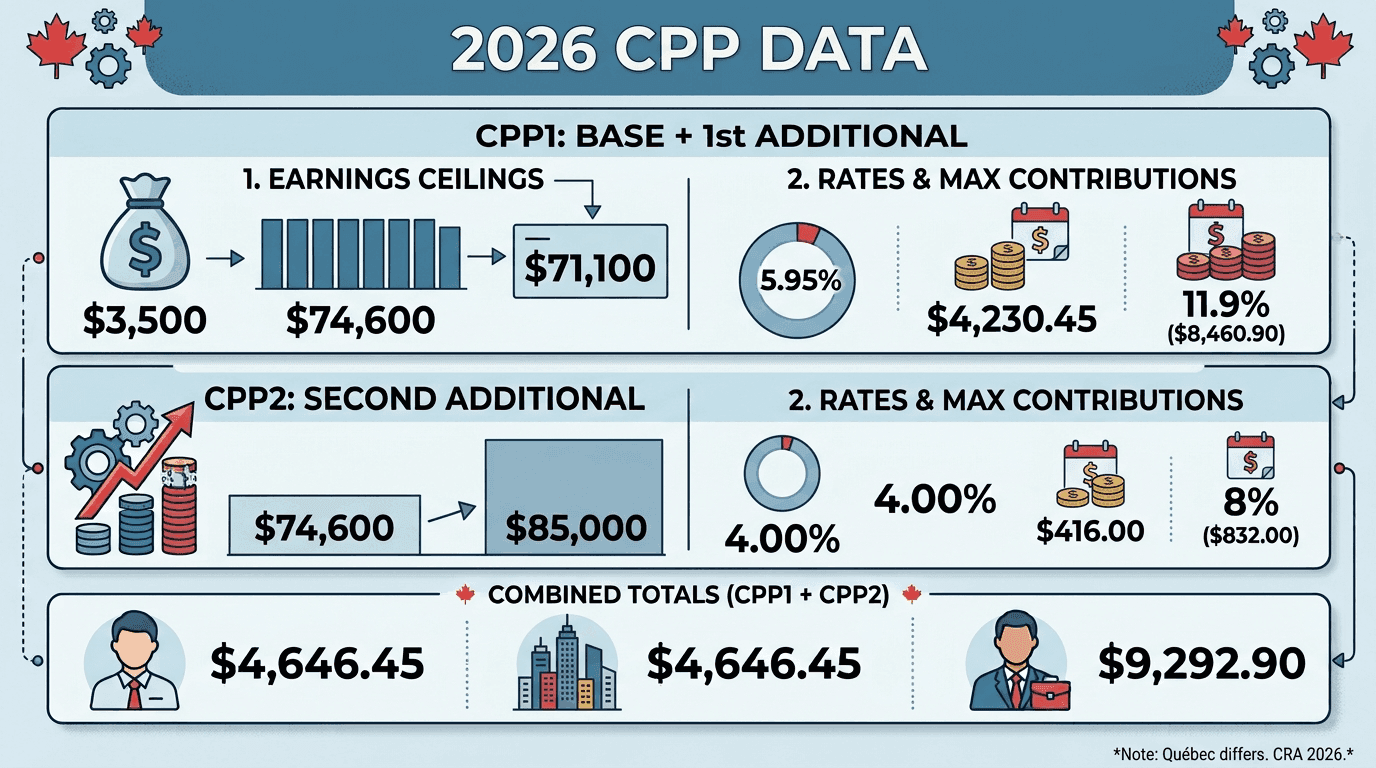
Base CPP (first tier): applies to pensionable earnings between the basic exemption of $3,500 and the Year's Maximum Pensionable Earnings (YMPE). For 2026, the YMPE is $74,600. The employee and employer rate is 5.95% each, for a maximum contribution of $4,230.45 per side.
-
CPP2 (second tier): applies to pensionable earnings between the YMPE and the Year's Additional Maximum Pensionable Earnings (YAMPE), a second, higher ceiling set at $85,000 for 2026. The employee and employer rate is 4.00% each, for a maximum contribution of $416.00 per side. Unlike base CPP, CPP2 has no basic exemption; every dollar in the band is contributory.
An employee earning below the YMPE only ever pays base CPP. An employee earning above it pays base CPP up to the YMPE, then CPP2 on the slice between the YMPE and the YAMPE. Nothing above the YAMPE attracts any further CPP contribution.
Put together, an employee at or above the YAMPE contributes a combined maximum of $4,646.45 in 2026, matched by an equal employer amount.
Self-Employed Individuals Pay Both Sides
Because a self-employed person is, for CPP purposes, both the "employer" and the "employee," the rates effectively double:
-
Base CPP: 11.90% (up to a maximum of $8,460.90)
-
CPP2: 8.00% (up to a maximum of $832.00)
-
Combined maximum: $9,292.90
This is calculated and remitted through the individual's T1 return rather than through payroll remittances, but the underlying earnings ceilings and exemption are identical to the employed calculation.
Quebec Employees: QPP, Not CPP
Employees who work in Quebec don't contribute to CPP at all; instead, they contribute to the Quebec Pension Plan (QPP), a parallel plan administered provincially rather than federally. QPP has its own contribution rate, its own basic exemption, and its own version of the second-tier enhancement, and the two plans are not interchangeable on a pay statement. A payroll system that defaults every employee to CPP regardless of work location will misstate deductions for any Quebec-based staff.
How the Earnings Ceilings Are Set
Employers don't set, and don't need to track legislation to predict, next year's ceilings from scratch, but it helps to understand where the numbers come from:
-
The YMPE is recalculated annually using a formula tied to growth in average weekly wages and salaries across Canada, which is why it moves up most years rather than staying fixed.
-
The YAMPE is set as a fixed percentage above the YMPE. From 2025 onward, that percentage is 14%; 2024, the first year CPP2 existed, used a transitional 7% gap.
-
The basic exemption of $3,500 is set in legislation and has not been indexed — it has stayed the same for decades, which means it shrinks in relative value every year wages rise.
Because the YMPE and YAMPE are announced each fall for the following calendar year, payroll teams generally have a few months' notice to update systems before the new figures take effect on January 1.
Does the CPP Rate Change What Employees Ultimately Owe?
Yes, but not because the percentages themselves moved — in most recent years they haven't. Almost all of the year-over-year increase in CPP deductions comes from the ceilings rising, not the rates. An employee whose pay hasn't changed at all can still see a slightly larger CPP deduction this January simply because the YMPE and YAMPE moved up while their earnings stayed flat relative to the exemption.
Example (Illustrative Only)
Priya, a marketing manager, earns $90,000 a year, paid biweekly. In 2025, her employer calculated her CPP contributions using a YMPE of $71,300 and a YAMPE of $81,200. In 2026, with no raise at all, the same $90,000 salary now sits against a YMPE of $74,600 and a YAMPE of $85,000, both higher.
The result: Priya pays base CPP on a larger band of earnings ($3,500 to $74,600 instead of $3,500 to $71,300) and CPP2 on a larger band as well ($74,600 to $85,000 instead of $71,300 to $81,200). Her total CPP withholding for the year goes up even though her salary didn't, and her employer's matching contribution rises by the same amount. Payroll teams that only reprogram the rate each January, without updating the ceilings, will under-deduct without realizing it.
CPP Compliance Matters
A well-managed CPP calculation process should ensure that:
-
Payroll systems are updated with the new YMPE, YAMPE, and maximum contribution figures before the first pay run of each calendar year.
-
Employees who cross the YMPE mid-year automatically shift into the CPP2 band without manual intervention.
-
Employees working in Quebec are correctly routed to QPP rather than CPP.
-
Employees who reach the annual maximum (for example, through a mid-year raise, bonus, or a second job) stop having CPP withheld for the remainder of the year, since over-withholding creates a refund problem at tax time rather than a compliance one, but still needs to be caught.
-
Employees turning 65 who have elected to stop contributing, or employees under 18 or over 70, are flagged correctly, since CPP contributions are not required outside the standard contributory age range absent an active election.
-
Self-employed contractors are not having CPP withheld by a payer who has misclassified them as employees, since self-employed individuals remit their own combined contribution through their tax return rather than through source deductions.
CPP Tip
Because the rate rarely changes but the ceilings almost always do, don't assume last year's payroll setup only needs a rate check in January. Confirm the current YMPE, YAMPE, and basic exemption directly against the CRA's published figures before the first pay run of the year, and build a mid-year check into your calendar to catch employees who cross the YMPE partway through the year, so the shift into CPP2 happens automatically rather than being caught after the fact.
***This article is for general information only and does not constitute payroll, tax, or legal advice. Always verify current rates and thresholds against official CRA and Revenu Québec publications before applying them to a payroll run.
References
Canada Revenue Agency. (2025). CPP contribution rates, maximums and exemptions.
Canada Revenue Agency. (2025). Second additional CPP contribution rates and maximums.
Canada Revenue Agency. (2025, November). Canada Revenue Agency announces maximum pensionable earnings and contributions for 2026 [News release].
Revenu Québec. (n.d.). Québec Pension Plan (QPP).