
Payroll Frequencies in Canada: A Payroll Compliance Essential
Payroll Frequencies in Canada: A Payroll Compliance Essential
Payroll Frequencies in Canada: A Payroll Compliance Essential
Payroll frequency is one of the first decisions an employer makes when establishing a payroll system. While there is flexibility in how often employees are paid, employers must ensure that their chosen payroll frequency complies with the applicable employment standards legislation and supports accurate and timely payroll administration.
Selecting an appropriate payroll frequency helps employers maintain compliance, meet employee expectations, and ensure statutory deductions and payroll records are processed correctly.
What Is Payroll Frequency?
Payroll frequency refers to how often employees are paid. It determines the length of each pay period and how frequently payroll is processed throughout the year.
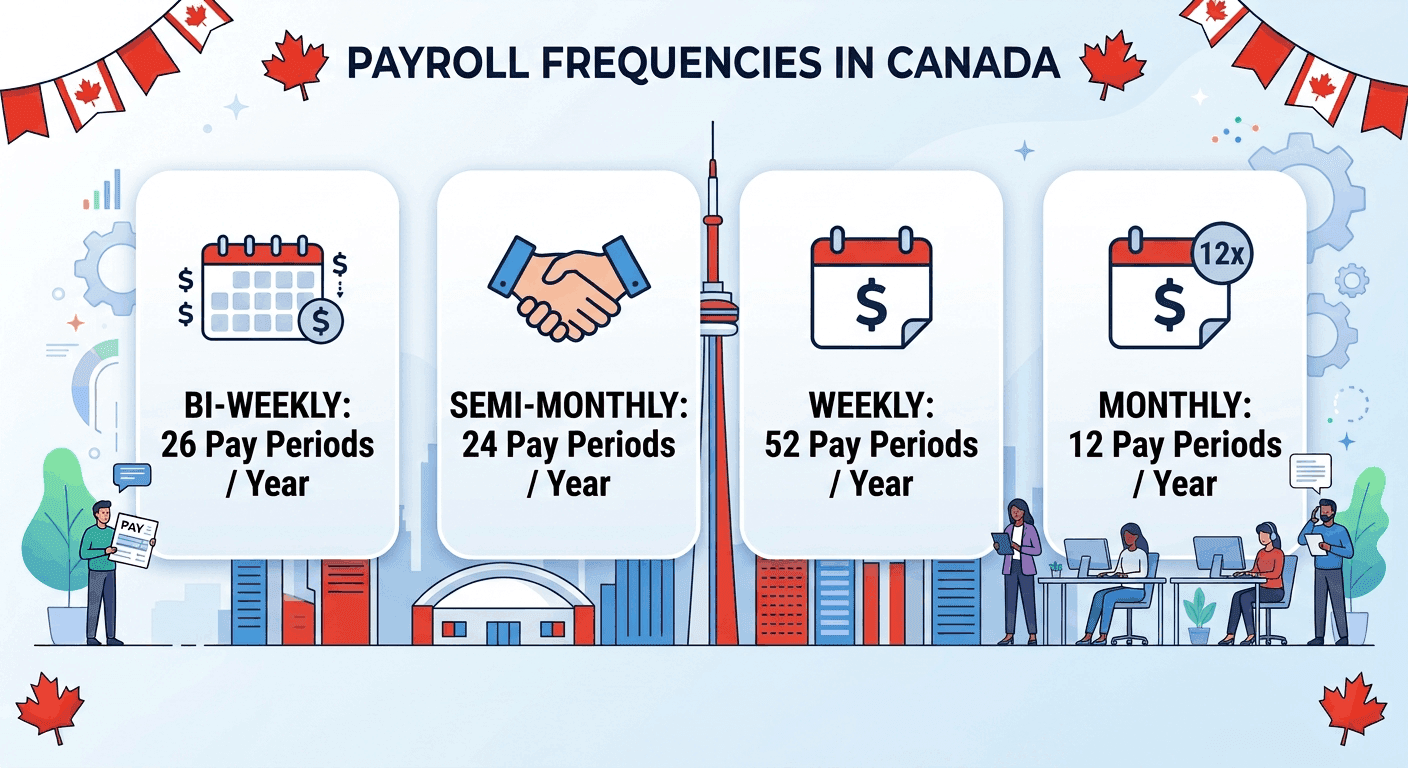
Common payroll frequencies in Canada include:
-
Weekly – Employees are paid once every week (52 payrolls per year).
-
Bi-weekly – Employees are paid every two weeks (26 payrolls per year).
-
Semi-monthly – Employees are paid twice each month, typically on fixed dates such as the 15th and the last day of the month (24 payrolls per year).
-
Monthly – Employees are paid once each month (12 payrolls per year).
The selected payroll frequency affects payroll processing schedules, statutory payroll calculations, remittance planning, and year-end reporting.
Payroll Frequency Requirements Differ Across Canada
A common misconception is that employers may choose any payroll frequency without restriction. In reality, employment standards legislation across Canada establishes minimum requirements regarding when employees must be paid, and these minimums vary by jurisdiction.
Depending on the applicable federal, provincial, or territorial employment standards legislation, employers may be required to:
-
Establish a regular, recurring pay period and pay day;
-
Pay employees within a specified period after the end of each pay period;
-
Maintain a consistent payroll schedule;
-
Provide employees with wage statements for each payroll; and
-
Comply with record-keeping requirements.
The applicable legislation is generally based on the employee's province or territory of employment, not where the employer's head office is located.
To illustrate how much these minimums can differ, here is how a few major Canadian jurisdictions currently define the outer limits of payroll frequency:
-
Federal (Canada Labour Code) – Federally regulated employers must pay wages on a regular, established pay day, but the Code does not fix a specific maximum interval between pay days the way several provinces do (Employment and Social Development Canada, 2026).
-
Ontario (Employment Standards Act, 2000) – Employers must establish a recurring pay period and a recurring pay day and pay all wages earned in a pay period no later than that pay day. The pay period can be weekly, bi-weekly, semi-monthly, monthly, or another set interval, provided it is consistent (Government of Ontario, n.d.).
-
British Columbia (Employment Standards Act) – Wages must be paid at least semi-monthly, pay periods cannot exceed 16 days, and all wages earned must be paid within 8 days after the end of the pay period (Province of British Columbia, n.d.).
-
Alberta (Employment Standards Code) – Employers must pay employees at least once a month and within 10 consecutive days after the end of the pay period (Government of Alberta, n.d.).
-
Quebec (Act respecting labour standards) – Wages must be paid at regular intervals not exceeding 16 days, except for senior managerial or contract personnel, who may be paid up to once a month; a new employee's first pay must be issued within one month of hire (CNESST, n.d.).
Because these minimums differ, a multi-provincial employer cannot assume that one payroll frequency, such as monthly, will be compliant in every jurisdiction in which it operates. A schedule that satisfies Alberta's "at least once a month" standard, for example, would not meet British Columbia's "at least semi-monthly" requirement.
How Do Employers Choose a Payroll Frequency?
When selecting a payroll frequency, employers should consider several operational and compliance factors, including:
-
The type of workforce (hourly, salaried, or a combination of both);
-
Payroll processing timelines;
-
Time required to collect and verify employee hours;
-
Cash flow and payroll funding requirements;
-
Statutory remittance deadlines;
-
The minimum frequency required in each province or territory where employees work; and
-
Internal payroll administration resources.
Many Canadian employers choose a bi-weekly payroll because it provides a balance between administrative efficiency and regular employee payments. However, the most suitable payroll frequency depends on the organization's operational needs and the applicable employment standards legislation.
Does Payroll Frequency Affect Employee Pay?
Payroll frequency changes when employees receive their wages, but it generally does not change their annual earnings.
For salaried employees, the annual salary is divided by the number of pay periods in the year. For example, an employee earning an annual salary of $78,000 would receive different gross amounts depending on the payroll frequency:
-
Weekly: $1,500.00 per pay
-
Bi-weekly: $3,000.00 per pay
-
Semi-monthly: $3,250.00 per pay
-
Monthly: $6,500.00 per pay
Although the amount paid each pay period differs, the employee's total annual earnings remain the same.
Employees may also notice differences in statutory deductions from one pay period to another, and not just differences in gross pay. This is because Canada Pension Plan contributions and Employment Insurance premiums are calculated using per-pay-period exemption and formula amounts that vary by pay frequency, and income tax withholding is calculated using tables or formulas specific to the pay period (Canada Revenue Agency, 2026a).
Example (Illustrative Only)
ABC Manufacturing hires a new salaried employee with an annual salary of $62,400. The company processes payroll on a bi-weekly basis, resulting in 26 pay periods each year.
The employee's gross salary is calculated as:
$62,400 ÷ 26 = $2,400.00 per pay period
If the employer later changes to a semi-monthly payroll schedule, the employee would instead receive:
$62,400 ÷ 24 = $2,600.00 per pay period
Although the gross pay per payroll increases, the employee's total annual salary remains $62,400. Statutory deductions may vary between the two schedules because payroll calculations are based on the applicable pay frequency and the CRA's payroll deduction formulas (Canada Revenue Agency, 2026b).
Payroll Compliance Matters
Employers are responsible for ensuring payroll is processed accurately and employees are paid in accordance with the applicable employment standards legislation.
A well-managed payroll process should ensure that:
-
Employees are paid on a regular and consistent schedule.
-
Payroll is processed within the legislated payment timelines for each jurisdiction in which employees work.
-
Statutory deductions are calculated using the correct payroll frequency.
-
Payroll remittances are submitted by the applicable due dates.
-
Payroll records and wage statements are maintained in accordance with legislative requirements.
Establishing a compliant payroll schedule helps employers meet their legal obligations while providing employees with predictable and timely compensation.
Payroll Tip: A consistent payroll schedule helps employers maintain compliance, accurately calculate statutory deductions, and ensure employees are paid on time. Before changing a payroll frequency, employers should verify the minimum pay frequency and payment-timing rules for every province or territory in which they have employees, and consider the impact on payroll processing timelines, employee communication, statutory remittances, and CRA deduction calculations.
References
Canada Revenue Agency. (2026a). T4127 – Payroll deductions formulas.
Canada Revenue Agency. (2026b). Payroll deductions and contributions.
https://www.canada.ca/en/revenue-agency/services/tax/businesses/topics/payroll.html
Canada Revenue Agency. (2026c). Payroll Deductions Online Calculator (PDOC).
Commission des normes, de l'équité, de la santé et de la sécurité du travail (CNESST). (n.d.). Pay.
https://www.cnesst.gouv.qc.ca/en/working-conditions/wage-and-pay/pay
Employment and Social Development Canada. (2026). Pay and minimum wage, deductions, and wage recovery.
https://www.canada.ca/en/services/jobs/workplace/federal-labour-standards/pay-deductions.html
Government of Alberta. (n.d.). Employment standards rules – Payment of earnings.
https://www.alberta.ca/payment-earnings
Government of Ontario. (n.d.). Your guide to the Employment Standards Act, 2000: Payment of wages.
https://www.ontario.ca/document/your-guide-employment-standards-act-0/payment-wages
Province of British Columbia. (n.d.). Getting paid for work.