
Remittance Frequency in Canada: A Payroll Compliance Essential
Remittance Frequency in Canada: A Payroll Compliance Essential
Remittance Frequency in Canada: A Payroll Compliance Essential
Remittance frequency is one of the least understood parts of payroll compliance, largely because it is easy to confuse with payroll frequency. Payroll frequency is how often an employer pays its employees. Remittance frequency is how often that employer must send the amounts withheld from those employees along with the employer's own required contributions to the Canada Revenue Agency (CRA) and, for Quebec employers, to Revenu Québec.
Unlike payroll frequency, remittance frequency is not a schedule the employer selects. It is assigned based on the employer's payroll deduction history, and it can change from one year to the next without any change in how or when employees are paid.
What Is Remittance Frequency?
Remittance frequency refers to how often an employer must remit source deductions — Canada Pension Plan (CPP) contributions, Employment Insurance (EI) premiums, and income tax withheld from employees along with the employer's matching CPP and EI contributions, to the CRA. The CRA groups employers into "remitter types," and each remitter type has its own remitting periods and due dates (Canada Revenue Agency, 2026a).
The current CRA remitter types are:
-
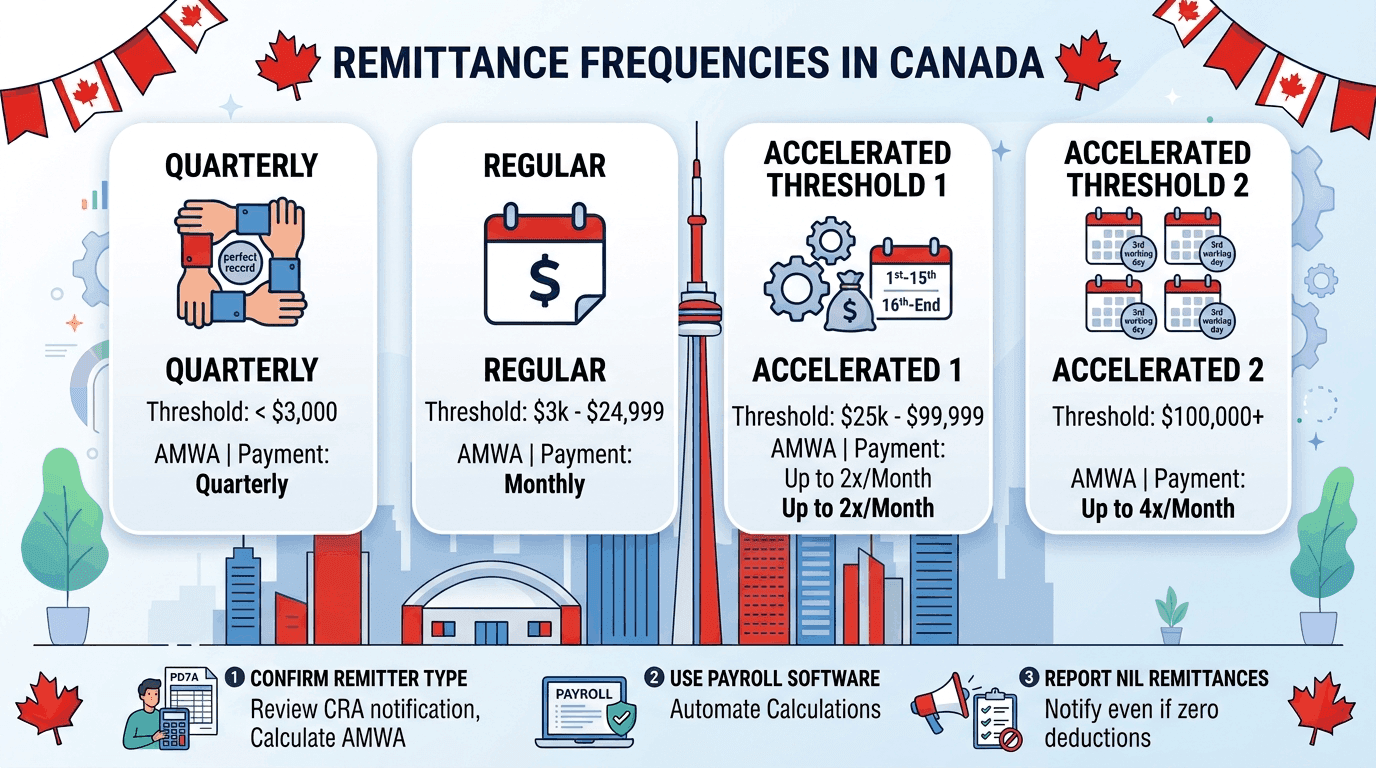
Quarterly – new small employer – Employers with a payroll account open less than 12 months, a monthly withholding amount under $1,000, and a perfect compliance record (4 remittances per year, due April 15, July 15, October 15, and January 15).
-
Quarterly – existing small employer – Employers with a payroll account open at least 12 months, an average monthly withholding amount (AMWA) under $3,000, and a perfect compliance record (4 remittances per year, same due dates as above).
-
Regular – Employers with an AMWA under $25,000 (12 remittances per year, due the 15th day of the following month).
-
Accelerated – Threshold 1 – Employers with an AMWA of $25,000 to $99,999.99 (up to 24 remittances per year, due the 25th of the same month for amounts withheld from the 1st to the 15th, and the 10th of the next month for amounts withheld from the 16th to month-end).
-
Accelerated – Threshold 2 – Employers with an AMWA of $100,000 or more (up to 48 remittances per year, due the third working day after each of the four weekly-style periods in a month: the 1st to 7th, 8th to 14th, 15th to 21st, and 22nd to month-end) (Canada Revenue Agency, 2026a).
The number and timing of remittances therefore has nothing to do with how many times a month employees are paid; it is driven entirely by the dollar amount of deductions an employer generates.
Remittance Frequency Requirements Differ by Remitter Type
A common misconception is that all employers remit on the same schedule, such as monthly. In reality, the CRA sets different remitting periods and due dates for each remitter type, and an employer has no discretion to choose a different one.
Depending on the employer's assigned remitter type, the CRA may require the employer to:
-
Remit quarterly, monthly, twice monthly, or up to four times a month;
-
Meet the applicable due date even when no remittance voucher has been received;
-
Report a nil remittance for any period in which no source deductions were made; and
-
Maintain a perfect compliance record on both payroll and GST/HST accounts to keep quarterly status (Canada Revenue Agency, 2026a; 2026b).
Quebec employers face an additional layer. Quebec income tax, Quebec Pension Plan (QPP) contributions, Quebec Parental Insurance Plan (QPIP) premiums, and the employer's Health Services Fund contribution are remitted separately to Revenu Québec, not the CRA. Revenu Québec assigns its own remittance frequency (annual, monthly, twice-monthly, weekly, or quarterly) based on the employer's average monthly remittance from two calendar years earlier, with quarterly remittances generally available to employers whose combined monthly source deductions and contributions are under $1,000 (Revenu Québec, n.d.a; n.d.b).
Because the CRA and Revenu Québec use different thresholds, review periods, and remittance categories, a Quebec employer's remittance frequency for federal source deductions is not necessarily the same as its remittance frequency for Quebec source deductions. Payroll teams operating in Quebec need to track both schedules independently.
How Is a Remitter Type Determined?
Employers do not choose their remittance frequency the way they choose a payroll frequency. Instead, the CRA assigns a remitter type based on:
-
The employer's average monthly withholding amount (AMWA), generally measured from the calendar year before the previous calendar year;
-
Whether the payroll account is new (open less than 12 months) or existing;
-
The employer's compliance history on its payroll and, where applicable, GST/HST accounts;
-
The CRA's annual review, with written notification if the remitter type changes; and
-
Any review the employer requests where specific conditions are met, such as an existing account that has qualified for quarterly remitting or an accelerated remitter whose AMWA has dropped (Canada Revenue Agency, 2026a).
The AMWA itself is calculated by taking the total of all required remittances in a calendar year and dividing that total by the number of months (to a maximum of 12) in which a remittance was required (Canada Revenue Agency, 2026a). A new employer with no remittance history defaults to quarterly remitting if its monthly withholding amount is under $1,000 and it maintains a perfect compliance record; otherwise, it is treated as a regular remitter until the CRA has enough history to assess it (Canada Revenue Agency, 2026a; 2026b).
Because the assignment is retrospective, an employer's remitter type for a given year reflects payroll activity from roughly two years earlier, not its current payroll size. A business can grow substantially in the current year while still remitting on last year's schedule, and vice versa.
Does Remittance Frequency Affect the Amount Owed?
Remittance frequency changes how often deductions are sent to the CRA, but it does not change how much is owed in total over the year. The full amount of CPP, EI, and income tax withheld from employees, plus the employer's required contributions, is due regardless of remitter type; only the size and timing of each individual remittance differs.
For example, an employer with an AMWA of $20,000 falls in the regular remitter category and would remit roughly $20,000 in up to 12 monthly payments, each due on the 15th of the following month. If that same employer's AMWA later rises to $30,000, it becomes a Threshold 1 accelerated remitter and would instead remit a comparable annual total in up to 24 smaller, more frequent payments, due on the 25th of the same month and the 10th of the following month. The annual liability to the CRA is driven by actual payroll activity either way; only the number and size of the remittances change.
Example (Illustrative Only)
Maple Ridge Contracting has had a payroll account open for several years. Two calendar years ago, its AMWA was $2,400, which qualified it as an existing small employer eligible to remit quarterly, provided it maintained a perfect compliance record.
As Maple Ridge Contracting hires more staff, its AMWA for the following measurement year rises to $27,000. Because this falls between $25,000 and $99,999.99, the CRA reassigns Maple Ridge Contracting as a Threshold 1 accelerated remitter for the next calendar year and notifies the company in writing.
Maple Ridge Contracting does not need to change how often it pays its employees; it can continue paying them bi-weekly. What changes is how often it sends deductions to the CRA — from four remittances a year to as many as 24 — and the due dates that apply to each remitting period.
Remittance Compliance Matters
Employers are responsible for remitting source deductions accurately and on the schedule assigned to their remitter type.
A well-managed remittance process should ensure that:
-
Remittances are sent using the correct remitter type and by the applicable due dates, even without a remittance voucher on hand.
-
Nil remittances are reported when no source deductions were made in a period, rather than left unreported.
-
Payroll staff monitor the AMWA throughout the year to anticipate a possible remitter type change before the CRA's written notice arrives.
-
Quebec source deductions and employer contributions are tracked and remitted to Revenu Québec on their own schedule, separate from CRA remittances.
-
Late or missed remittances are avoided, since the CRA applies escalating penalties — 3% for payments 1 to 3 days late, 5% for 4 to 5 days, 7% for 6 to 7 days, and 10% for more than 7 days late or unremitted, doubling to 20% for a repeated failure in the same calendar year — plus daily compounded interest from the due date (Canada Revenue Agency, 2026a).
Establishing a compliant remittance process helps employers avoid penalties and interest while ensuring the CRA, and where applicable Revenu Québec, receive statutory deductions on time.
Remittance Tip: Because remitter type is assigned by the CRA rather than chosen by the employer, it can change from one year to the next as payroll activity grows or shrinks — even if pay frequency stays exactly the same. Confirm your current remitter type through CRA My Business Account rather than assuming last year's schedule still applies, and build remittance due dates into your payroll compliance calendar as a separate line item from pay dates.
References
Canada Revenue Agency. (2026a). When to remit (pay).
Canada Revenue Agency. (2026b). Types of remitters.
Canada Revenue Agency. (2026c). Remit (pay) payroll deductions and contributions.
Canada Revenue Agency. (2026d). Employers' Guide – Payroll Deductions and Remittances (T4001).
Revenu Québec. (n.d.a). Frequency of remittances and due dates.
Revenu Québec. (n.d.b). Average monthly remittance.